
In the world of large-tonnage molding and structural foam, the potential advantages of a consistent tooling partner are often overlooked in the quest to save money. There is a common myth that putting every new tool out to competitive bid is “good procurement.” On the surface, it makes sense: more quotes, more leverage, better pricing.
But after years of seeing these programs through from CAD to the assembly floor, I’ve realized that chasing the lowest bid on every tool usually ends up costing more than it saves. There is a hidden cost to “starting over” with a new shop that doesn’t show up in a quote, but it absolutely shows up in your production timeline and your scrap rates.
The Silent Education Period in Structural Foam Tooling
Every time you hand a project to a new tool shop, you’re paying for an education period. You aren’t just buying a mold; you’re teaching that shop your specific “language” of manufacturing:
- Your wall section requirements and cosmetic call-outs.
- Tolerance stack-ups and shrink factor expectations.
- The specific quirks of your downstream assembly.
By the second or third project with a consistent partner, that education is already “baked in”. They already know you run semi-crystalline resins with higher shrink rates. They remember that your parts have deep ribs that tend to trap air, so they build in the venting before you even have to ask.
In structural foam specifically, where tools are often aluminum, this institutional knowledge is worth real money. It’s also critical that your molder is involved in the tooling phase. Better yet, utilize their vetted network of specialized outside tool shops. By choosing a partner who already has your molder’s criteria specified, you gain access to cross-industry engineering expertise and a built-in system of checks and balances that an in-house shop simply can’t match.
Structural Foam Tool Modifications: Surgery vs. Guesswork
Eventually, every tool may a modification. Maybe it’s a geometry change based on customer feedback, refurbishment after hundreds of thousands of shots, or a process optimization. When the shop that built the tool handles the modification, they aren’t guessing. They have the original CAD, and they know exactly where the cooling lines run and how thick the aluminum is in any given area.
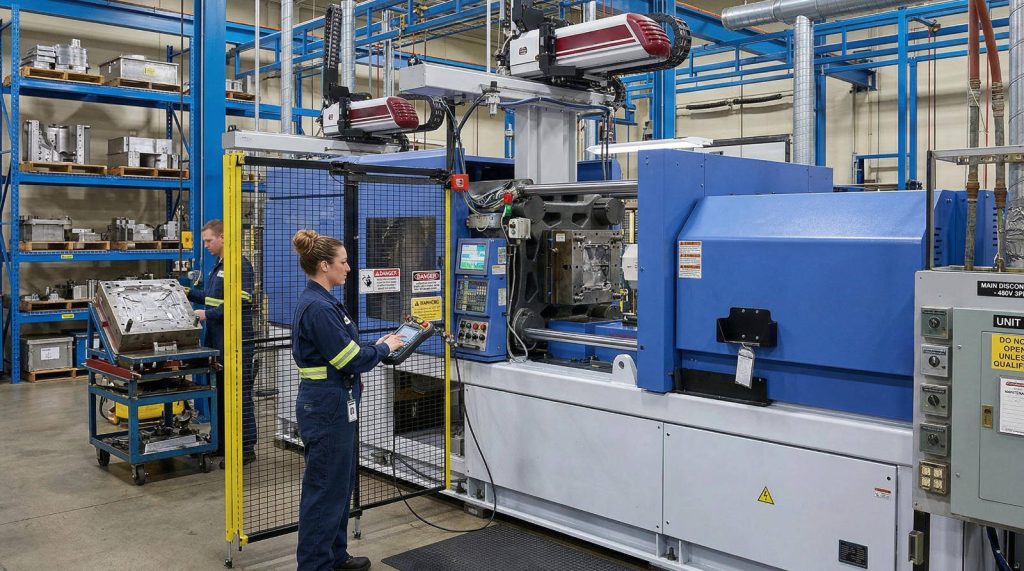
When you send that tool to a new shop to save a few dollars on an ECO (Engineering Change Order), you’re asking them to perform surgery on a patient they’ve never met. They have to reverse-engineer the design, often without complete documentation, making judgment calls on geometry they don’t fully understand. That introduces massive risk to the original investment.
For structural foam, this is even more critical. These tools have specific design intents around parting line venting and intentional “flex” to accommodate part geometry. A shop unfamiliar with those original decisions can unknowingly compromise the entire tool during a “simple” modification.
The Family Tooling Fit Problem in Structural Foam
If you’re building a multi-part product, like an enclosure with a lid, a base, and a mounting panel, dimensional harmony is everything. Parts have to fit together, and assembly tolerances stack up quickly.
When one shop handles the entire “family,” they apply:
- Consistent Shrink Calculations The lid and the base are designed with the same mathematical assumptions.
- Shared Parting Line Logic They interpret the geometry the same way across every part.
- Molder-Friendly Standards They use similar cooling layouts and ejection strategies, which makes setup and troubleshooting much faster for your molder.
Split those tools across four different shops, and you’re practically inviting a fitment crisis on the assembly floor. Tracking down the root cause when Vendor A blames Vendor B is a project management nightmare you don’t want.
Tooling Relationship Capital and the Bottom Line
This is the part that isn’t on the spec sheet: a shop that has built five tools for you will treat your sixth project differently than a first-time customer. When your schedule gets tight or a change order needs to move now, that relationship capital is what gets your job prioritized on the shop floor.

They quote faster because they know your standards. They manage your IP and NDAs more securely because fewer vendors have your data. You get one point of contact instead of managing a dozen different purchase orders and lead-time conversations.
Sole-Source Tooling: Strategic Considerations
Is a sole-source relationship perfect? No. You have to watch for pricing drift and make sure the shop isn’t getting complacent. You also have to factor in geography; if the shop is too far from your molder, shipping costs can eat into your savings.
But we manage those risks through engagement, periodically checking prices against the market and being honest about performance. In the long run, the most efficient path is almost always the one where your tool shop already knows your work.
If you’re weighing whether to consolidate your structural foam tooling with one partner or keep spreading it around, let’s talk. We’ve helped OEMs work through exactly this decision. Reach out to start the conversation.
Recent posts

Controlling the Core: A Technical Look at the Gas-Assist Injection Molding Process
Posted on July 14, 2026
How to Transition from Sourcing to Purchasing Without Losing Momentum
Posted on April 22, 2026
The Benefits of Maintaining a Structural Foam Tooling Partner Across Projects
Posted on April 13, 2026