
If you are sourcing large industrial parts, like heavy-duty event flooring, industrial/lawn & garden housings, or water control products like trench drains, you probably already know that the “mold” (the tool) is the most expensive and important part of the process.
But there is a big question you should ask your manufacturing partner: “Do you build your molds in-house, or do you use an outside network of specialized tool shops?”
While having an in-house shop sounds convenient, for large-scale injection or structural foam parts, working with a molder who uses an outside network of independent shops actually offers better results, lower risks, and more innovation. Here is why.
Diversity of Experience: They’ve Seen It All
In-house tool shops usually only build one type of tool for one type of customer. Outside tool shops, however, are constantly tackling a massive variety of challenges across many different industries.
Because they work with a diverse range of projects, like medical devices and heavy industrial goods, they have already “solved” challenges you are likely to face. From tricky geometries for a trench drain to durability requirements for event flooring, these shops bring a library of past successes to your project that an in-house shop simply can’t match.


Cross-Industry “Brain Power”
While an in-house shop operates within the specific technical scope of its parent company, independent tool shops serve as innovation hubs. This external perspective allows them to adapt advanced engineering solutions from sectors like medical or aerospace and apply them to your industrial parts to make them stronger, lighter, or more precise. You benefit from a high-level exchange of ideas from across the manufacturing world, ensuring your product is built using the latest industry-wide best practices.
Built-In Checks and Balances: Two Sets of Eyes on Your Asset
When a manufacturer builds a tool in-house, the process often lacks the benefit of independent verification. Any internal adjustments made during the build may occur without a “second opinion” or formal third-party review. For a high-value, six-figure asset, this localized approach can introduce risks that remain hidden within a single facility.
Utilizing an outside network establishes a natural system of checks and balances. Since the molder is responsible for successful production, they perform a rigorous inspection before accepting the tool into their facility. Knowing the work will be closely reviewed, the tool shop is incentivized to meet the highest standards of precision. This creates a scenario where both parties are personally invested in protecting your capital investment.
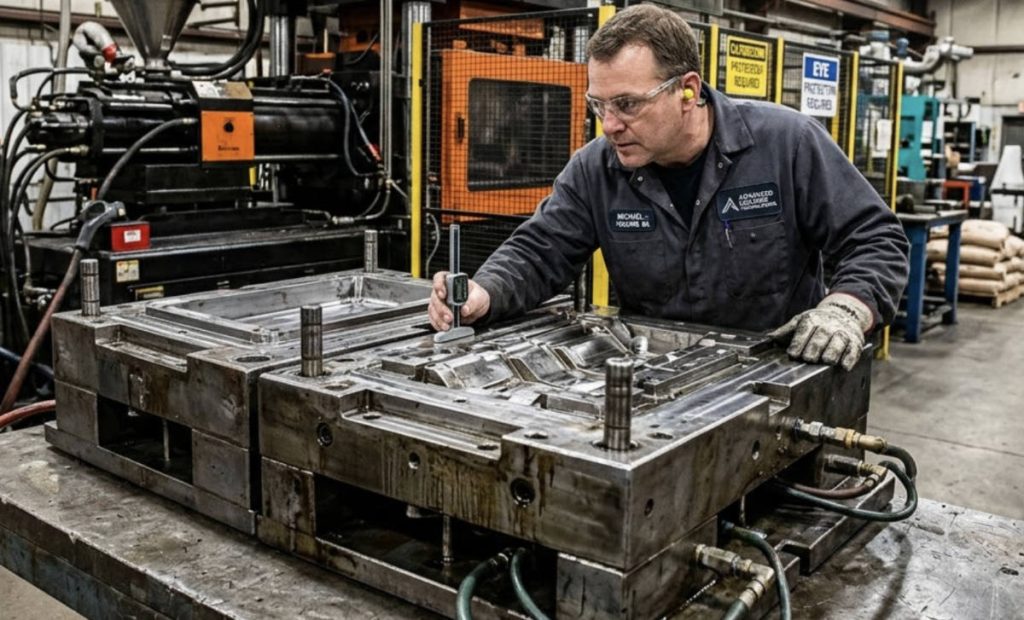
This accountability works in both directions. When a tool returns to an independent shop for repairs or maintenance, the condition of the mold reveals exactly how it was treated during production. If a molder omits preventive maintenance or proper shutdown procedures, an outside specialist can identify those patterns immediately. This provides a consistent layer of oversight, ensuring your asset is managed with the highest level of care throughout its entire lifecycle.
Better Financials: Pay for What You Use
Running a top-tier tool shop is incredibly expensive. It requires multi-million dollar CNC machines and a team of highly paid specialists. If a molder has an in-house shop, they have to pay for those machines and salaries even when they aren’t busy. Guess who eventually pays for that overhead? The customer molding the parts.
When you work with a molder using an outside network, you only pay for the specific expertise and machine time needed for your project. You aren’t subsidizing the molder’s idle machinery or expensive staff during their slow months.
Faster Timelines (Simultaneous Starts)
If you need five different molds for a new product line, an in-house shop often has to build them one after another because they have a limited number of machines and people.
A specialized outside shop, however, has a much larger “machinery fleet.” They have the scale to get all of your tools started at once on multiple machines. Instead of waiting months for five tools to be finished in a row, you can have your entire product line move into production simultaneously, significantly shortening your time to market.
Specialized Equipment for Massive Parts
Big parts need big machines. Some structural foam parts can be over 7 feet long or weigh 100 pounds. Most in-house shops can’t justify buying the massive, 5-axis CNC machines required to cut a mold that size.
By using an outside network, your molder can pick a shop that specifically owns these “heavy hitters”—the massive equipment designed to handle extra-large industrial tooling with high-speed precision.
Questions to Ask Your Molder
Before you sign off on your next large-scale project, ask these questions to ensure you’re getting the best tooling strategy:
- Is the tooling outsourced? (Understand if they use a specialized network or a limited in-house shop).
- Do you charge a management fee for working with outside shops?
- Who owns the tool? (Always ensure you have clear legal ownership of the mold).
- When nozzle rods & barrels are built & paid for, is it the full assembly that needs built or only the lengths specific to our mold? Who owns which portion of these?
- Can the shop handle “parallel starts” for multiple tools at once?
The Bottom Line
For large, complex injection structural foam projects, don’t limit yourself to what one in-house shop can do. Choose a partner that gives you access to the best machines and the most diverse engineering minds in the business. It’s the smartest way to reduce your risk and get a better product to your customers faster.
Recent posts
Controlling the Core: A Technical Look at the Gas-Assist Injection Molding Process
Posted on July 14, 2026
How to Transition from Sourcing to Purchasing Without Losing Momentum
Posted on April 22, 2026
The Benefits of Maintaining a Structural Foam Tooling Partner Across Projects
Posted on April 13, 2026