
Tolerances and Warpage Control
| Commercial Tolerance Ranges for HDPE Parts | ||||||
|---|---|---|---|---|---|---|
| Part Size | 10.00"(254 mm) | 20.00"(508 mm) | 30.00"(762 mm) | 40.00"(1026 mm) | 50.00"(1270 mm) | 60.00"(1524 mm) |
| Tolerance +/- | 0.045"(1.14 mm) | 0.105"(2.66 mm) | 0.180"(4.57 mm) | 0.240"(6.09 mm) | 0.300"(7.62 mm) | 0.360"(9.14 mm) |
These are commercial reference tolerances. Tighter tolerances are achievable on specific dimensions and geometries — case-by-case, not as a blanket capability. The most common places tightening is worth pursuing:
- Critical interface dimensions on multi-part assemblies.
- Mating surfaces where the structural foam part contacts another molded or machined component.
- Mounting boss locations and patterns where bolt-circle accuracy matters.
Final part dimensions in structural foam are affected by thermal expansion and contraction during cooling, processing conditions (cycle time, melt temperature, gas pressure on gas-assist), tool dimensions and design, material specification, and part geometry. Tolerance and warpage are best controlled by consistent density reduction across the part — which in turn is best controlled by uniform wall thickness, minimal restrictions to material flow, gating placement that supports even fill, and keeping flow lengths within the material's recommended range. Structural foam can achieve tighter tolerances and flatter parts than equivalent injection molding on large geometries, because the lower cavity pressures produce lower induced stresses and less warpage.
Surface Finish and Secondary Operations
Structural foam parts come off the mold with an as-molded surface finish that varies by process. Single-nozzle parts typically show some swirl and flow lines, especially farther from the gate. Multi-nozzle parts show less of this — shorter flow lengths from each nozzle produce a cleaner surface. Gas-assist parts produce the smoothest as-molded surface of the three, with most of the cellular structure pushed inward by the gas pressure leaving a denser, smoother skin. For many applications — industrial parts, dunnage, structural components, anything where cosmetics are secondary — the as-molded surface is the finished surface.
The progression from as-molded to highest cosmetic finish:
- As-molded: Direct from the press. Textured to slightly swirled, matte. No additional cost beyond molding.
- Sanded: Surface smoothed to remove swirl and prepare for further finishing. Adds labor cost.
- Primed: Sanded surface coated with primer for paint adhesion.
- Color coat: Primed surface coated with paint in the specified color.
- Textured: Color-coated surface treated with texture coating for a tactile and visual finish.
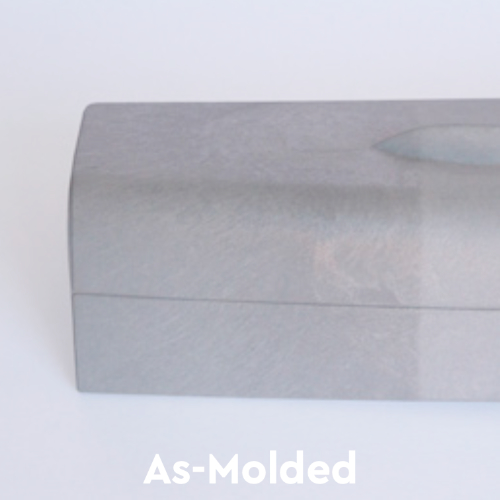 1. As-Molded
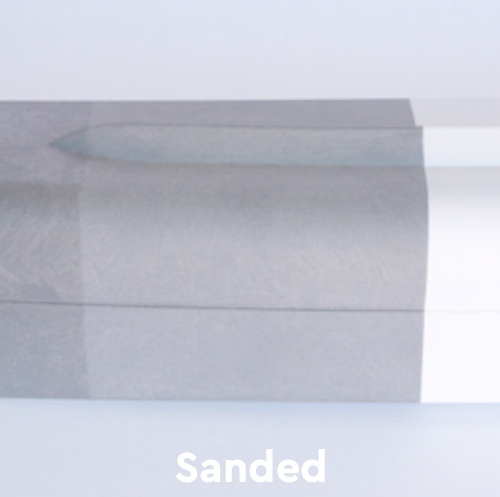 2. Sanded
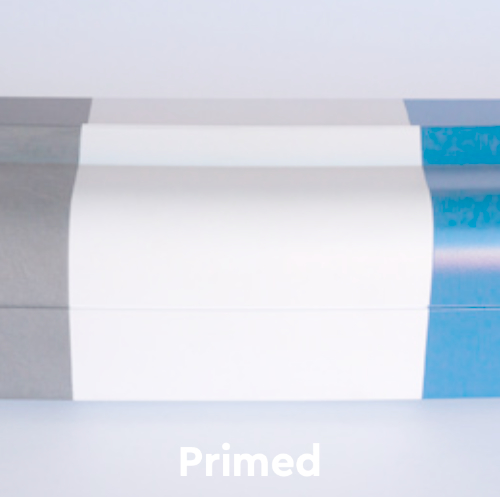 3. Primed
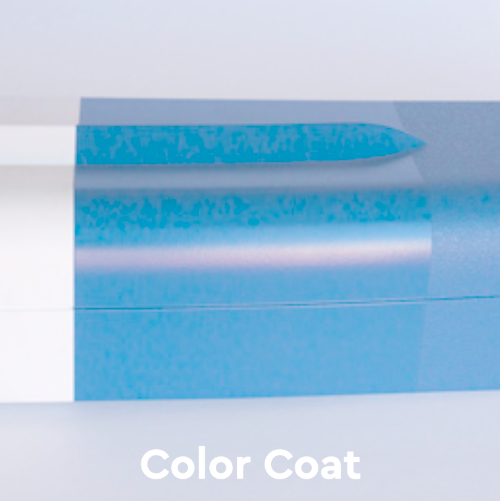 4. Color Coat
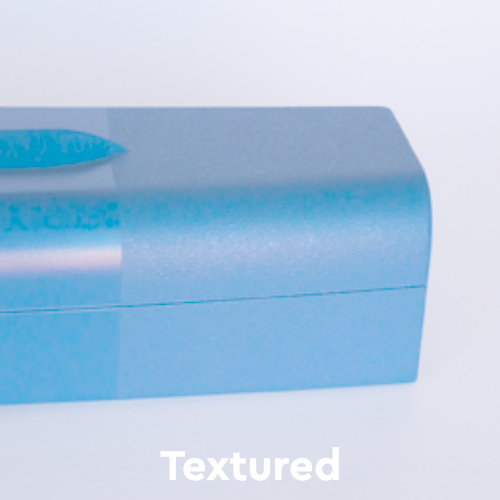 5. Textured
Each step in the progression adds cost and lead time. A part that needs a Class A automotive-equivalent finish on a structural foam substrate is achievable, but it requires the full progression and should be budgeted accordingly at quote.
Materials
| Material | Tensile Strength | Stiffness | Impact Resistance | Compressive Strength | Combustibility Rating | Price Comparison |
|---|---|---|---|---|---|---|
| ABS | ●●●● | ●●●● | ●●●● | ●●●● | ●●●● | ●●●● |
| HDPE | ●● | ●● | ●●● | ●● | ●● | ●● |
| HIPS | ●●● | ●●●● | ● | ●●● | ●● | ●●● |
| PP | ●●● | ●●● | ●● | ●● | ●●● | ●● |
Four resins make up the structural foam workhorse set: Acrylonitrile Butadiene Styrene (ABS), High-Density Polyethylene (HDPE), High Impact Polystyrene (HIPS), and Polypropylene (PP). Selection logic, simplified:
- ABS: Strong across the board: high tensile strength, high stiffness, high impact, strong cosmetic finish potential. The go-to choice when the application needs structural performance plus a finishable surface, and price is acceptable.
- HDPE: The standard for outdoor, weather-exposed, and chemical-exposed parts. Lower stiffness than ABS but excellent impact resistance and weatherability, plus the lowest price among the four.
- HIPS: High stiffness, lower impact than ABS, mid-range price. Common in interior or indoor structural applications.
- PP: Chemical-resistant, lower stiffness, mid-range impact, mid-range price. Selected for chemical compatibility or specific property needs.
Beyond the headline four, filled and specialty grades are available on application, including Glass-filled HDPE and glass-filled PP, Mineral-filled grades, and Flame-retardant grades. All materials run in virgin prime, wide-spec virgin, or regrind grades. For non-cosmetic structural parts, regrind and exploring the full resin spectrum is often the right answer on cost and sustainability terms. Structural Foam Molding molded over 50 million pounds of recycled material last year.
Sustainability Engineering & Guidance
Many structural foam applications can incorporate up to 100 percent recycled content, and all of our production materials are scrap and regrind eligible. The engineering trade-off is real but manageable: recycled content affects cosmetic consistency, color matching, and (in some grades) impact and tensile properties. For non-cosmetic structural parts, high-percentage recycled content is often a free win.
Not sure which resin fits your application? Talk to our engineering team.
Assembly Methods
Structural foam parts assemble using most of the same methods as injection-molded plastic parts. The structural advantage of the process — the ability to mold large parts with integrated features (bosses, ribs, mounting points, snap-fits) — often reduces the assembly burden in the first place. When assembly is required, the working options:
Self-tapping fasteners
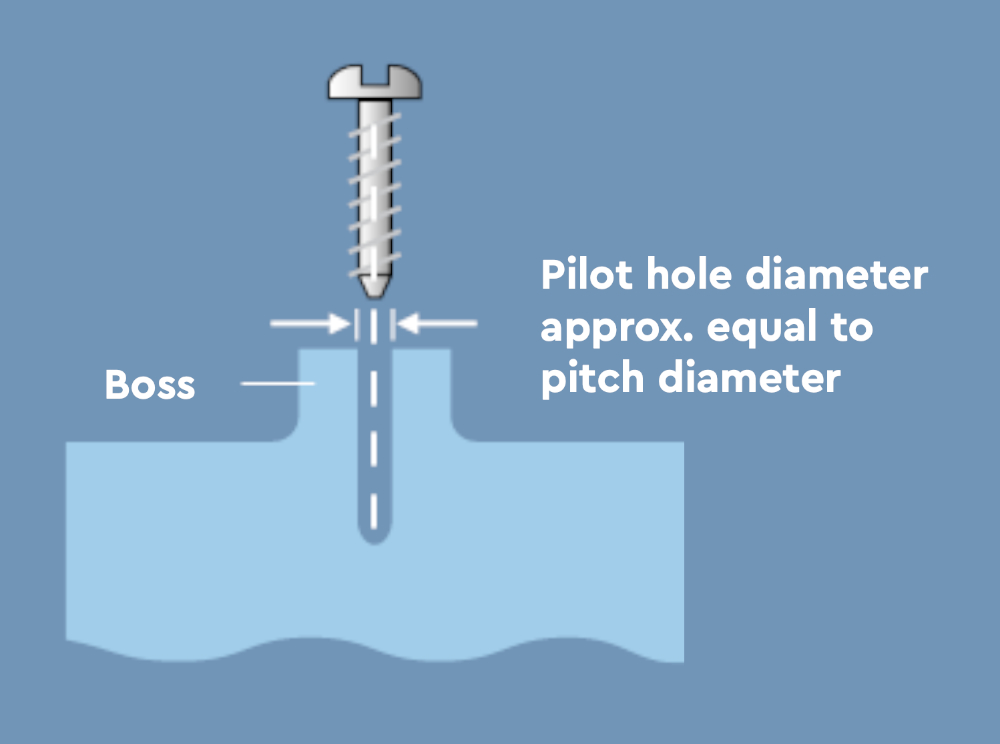 Figure: Self-tapping screw installation in a structural foam boss, detailing proper pilot hole diameter.
For permanent assemblies or assemblies that will be disassembled fewer than ten times over the part's service life, self-tapping screws into molded bosses are the standard. Thread-rolling screws are preferred over thread-cutting screws — structural foam's low molded-in stress and cellular core respond better to thread-rolling, which deforms material rather than removing it. Pilot hole diameter should equal the screw's pitch diameter, and pilot holes should be molded in rather than drilled wherever possible.
Press-in threaded inserts
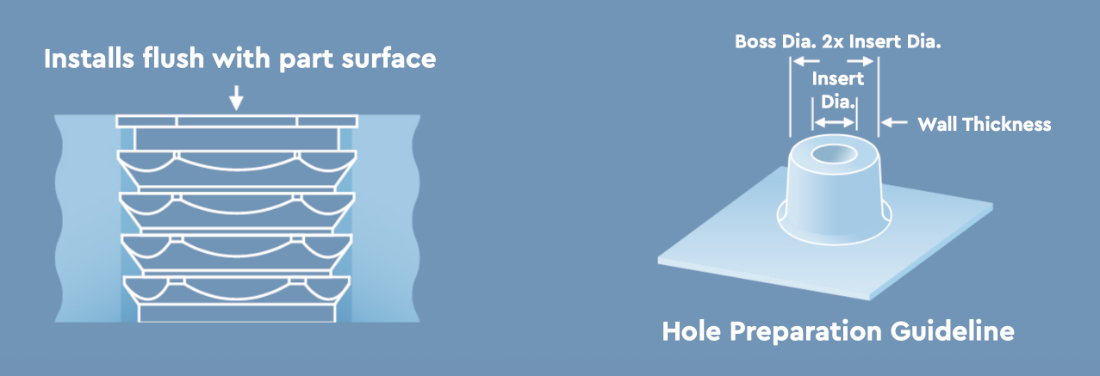 Figure: Press-in threaded insert installation flushness and boss layout guidelines.
For assemblies that will be repeatedly disassembled and reassembled — service access, modular configurations, field assembly — press-in threaded inserts are the standard choice. Press-fit into molded or drilled holes using any standard press; no heat, no ultrasonic equipment, no insert molding required. They provide strong, reusable threads, high torque-out and pullout values, and install flush with the part surface. Hole geometry: Boss outside diameter at twice the insert diameter, hole diameter per the insert manufacturer's spec. Available in aluminum, stainless steel, and standard brass/steel grades.
Snap-fits
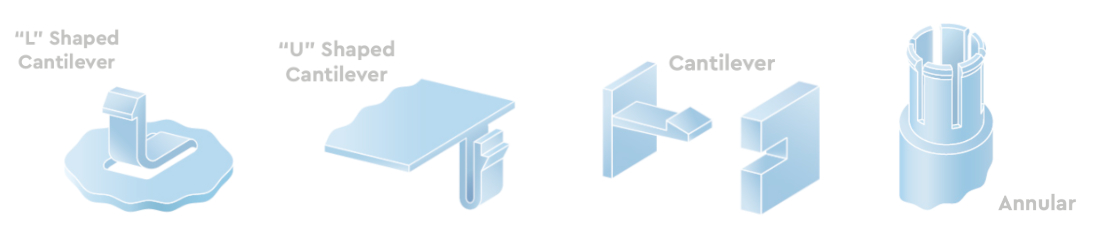 Figure: Four common snap-fit joint designs: cantilever, U-shaped, L-shaped, and annular.
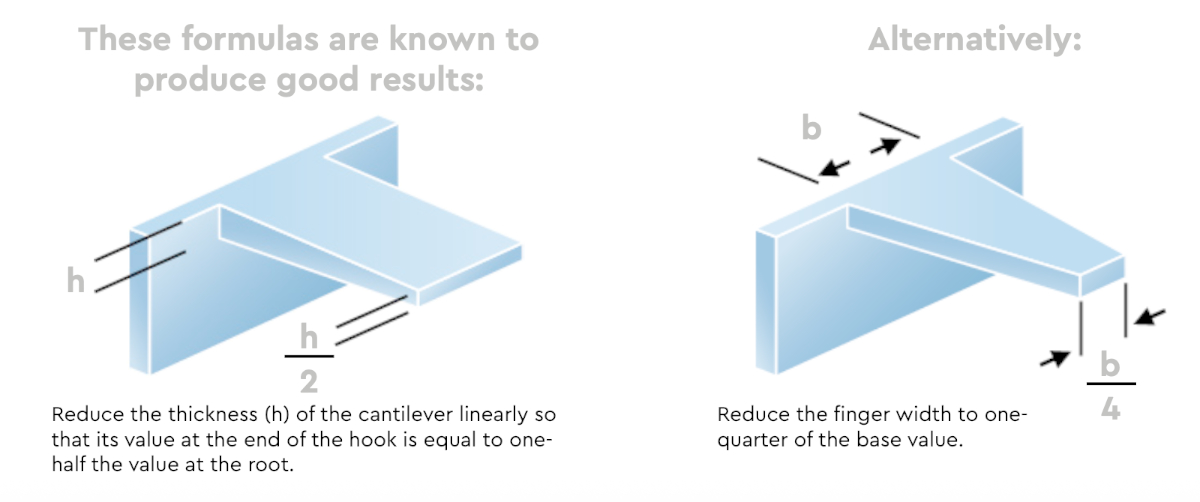 Figure: Cantilever snap-fit design tapering approaches (thickness and width reduction).
Snap-fit joints are the cost-efficient assembly option for parts that mate to other plastic components. The dimensional rules: Fillet radius at the finger root must be at least 50 percent of wall thickness (R/t ≥ 0.50). Most snap-fit failures originate at the root from stress concentration; a generous root fillet fixes this. Minimum root radius in any case: 0.015 inches. Taper the finger from root to tip: either reduce thickness linearly to h/2 at the hook, or reduce width to b/4 at the hook. Snap-fits do add tool cost via slides, though this can often be avoided by adding a slot in the wall directly below the undercut or by placing the snap on a part edge facing outward.
Beyond fasteners and snap-fits, parts can be assembled via ultrasonic welding, hot plate welding, insert molding, and overmolding.
Comparing Structural Foam to Other Processes
Structural foam vs. high-pressure injection molding
Injection molding usually wins on small parts that fit in your hand, walls thinner than about 0.180", and parts that need a Class A finish right out of the tool. Structural foam opens up when any dimension runs past about twelve inches, walls go 0.250" or thicker, you're replacing a metal or wood part, or you've got a multi-piece assembly that could collapse into one part. Plenty of parts could go either way and it comes down to volume, tooling budget, and what the part has to do in service. Send us the model. If structural foam isn't the right call, we run traditional injection molding too and we'll tell you which way to go.
Structural foam vs. rotomolding
Rotomolding wins on hollow parts. Tanks, drums, double-wall enclosures, and single-wall hollow geometries are rotomolding territory — no other process produces a hollow part as efficiently. Rotomolding also wins on low-volume programs where tooling investment needs to be minimal. Structural foam wins on rigid, solid-wall parts with integrated features, on parts that need tighter tolerances than rotomolding produces, and on higher production volumes where rotomolding's longer cycle times become a constraint. If your part is structurally rigid with bosses, ribs, snap-fits, or mounting features, structural foam is usually the right call. If it is a hollow container, it is not.
Structural foam vs. thermoforming
Thermoforming wins on thin shells, on parts with low tooling budgets, and on simple geometries where the formed shape can be trimmed from a sheet. Vacuum-formed and pressure-formed parts are cost-efficient at low volumes with minimal tooling investment. Structural foam wins on parts with structural requirements, integrated features, or geometries that cannot be formed from sheet — anywhere bosses, ribs, internal walls, or tight three-dimensional features matter. Production volumes above the thermoforming break-even (which varies but typically lands in the low thousands per year on substantial parts) also favor structural foam.
To evaluate our full range of network solutions, you can see our complete capabilities at Miles Products.
Total Landed Cost Considerations
Piece price is the wrong way to evaluate a structural foam part against alternatives. The process's total-cost advantages — and disadvantages — show up in places that do not appear on a per-part quote line.
- Assembly elimination: A multi-piece assembly that requires brackets, fasteners, and hand labor at every unit can often consolidate into a single structural foam part with molded-in bosses, ribs, and mounting features. Eliminating that secondary assembly removes labor, fastener cost, inventory lines, and quality variation. On programs where assembly time is the bottleneck, labor savings alone can offset tooling differentials within the first production run.
- Integrated features: Bosses, ribs, snap-fits, mounting points, and hinge bosses can all be molded into the part. Each integrated feature is a part not bought, a fastener not specified, an assembly step not run.
- Tooling: Aluminum tools cost less than hardened steel injection tools, run faster cycles (better heat transfer), and have shorter lead times.
- Shipping weight: Structural foam parts are 10 to 15 percent lighter than the equivalent injection-molded part. For an OEM shipping thousands of large parts a year, the freight math alone can justify structural foam over heavier alternatives.
- Service life and durability: Structural foam parts are resistant to weather, chemicals, and corrosion. Replacement cycles cost more than the original piece price, every time.
- Stocking and supply chain: Material stocking reduces production lead time by removing the resin-procurement window. Finished-goods stocking enables same-week or next-week response on repeat orders.
Want to consolidate suppliers? We handle assembly, kitting, and stocking in-house. Talk to us.
Common Design Mistakes
Here are the ones I actually see when an RFQ hits my desk:
- Wall thickness from injection molding instinct: Below 0.180 inches you do not get a cellular core — you get a thin solid wall with no structural benefit and a lot of trapped problems. Bump the wall to 0.250 inches nominal and the part actually does what you want it to do.
- Wall thickness going the other way — too thick: In structural foam, walls thicker than 0.500 inches do not add proportional strength. What they add is cycle time, material cost, sink potential, and longer cooling cycles.
- Blanket tolerancing across the whole part: Material shrinks, and trying to hold tight tolerances on every feature drives cost and quality issues with no purpose. Tolerance what matters — mating surfaces, mounting holes, interface dimensions. Open up everything else.
- Boss design from injection molding playbook: In structural foam, making boss walls equal to nominal wall thickness is a recipe for sink and voids on the back side. Boss walls want to be roughly 60 percent of nominal wall, with gussets for structural load.
- Sharp inside corners: A sharp inside corner is a stress riser and a flow problem. Generous radii fix it.
- Ribs that don't do what the engineer thinks they do: Too tall and they sink. Too thin at the top and they do not fill. Shorter than 0.180 inches and the rib fills solid and acts like a heat sink.
- Class A finish without budgeting secondary operations: To get there from as-molded, you need sand, prime, color coat, and clear. Each step has cost and lead time.
- Picking structural foam for parts that should be rotomolded or injection molded: Trying to make a 6" × 4" × 2" enclosure? That's an injection molding part. A hollow water tank? That's a rotomolded part. Structural foam is for large rigid parts with structural requirements where strength-to-weight matters.
- Gating decisions made without consulting on flow paths: Designers will spec gate locations on the drawing without modeling flow. Putting gates in the wrong location creates weld lines and cosmetic issues that show up at PPAP. Leave gate location off the print and let the molder optimize.
The design engineer is applying instincts from a different process. Structural foam is its own thing. If you have a structural foam part in design, send us the print before you finalize it. That call is free, and it saves the most expensive mistake — building a tool to a print that does not fit the process.