
Introduction
Many on our team have been molding structural foam parts for over forty years. The pattern is consistent: get the design right up front and you build cheaper, faster, and with fewer revisions. Getting the design wrong leads to expensive lessons. This guide is meant to keep your part on the cheap path.
It covers the dimensional rules, the material guidance, and the design mistakes we see most often when an RFQ hits the desk. It also covers something most process guides skip: when structural foam isn't the right answer, and what process is. It is written for design engineers, product managers, and sourcing managers spec'ing large rigid plastic parts. It assumes you have geometry in hand or in progress, and that you are deciding whether structural foam fits your part — or, if you've already decided, how to design it well.
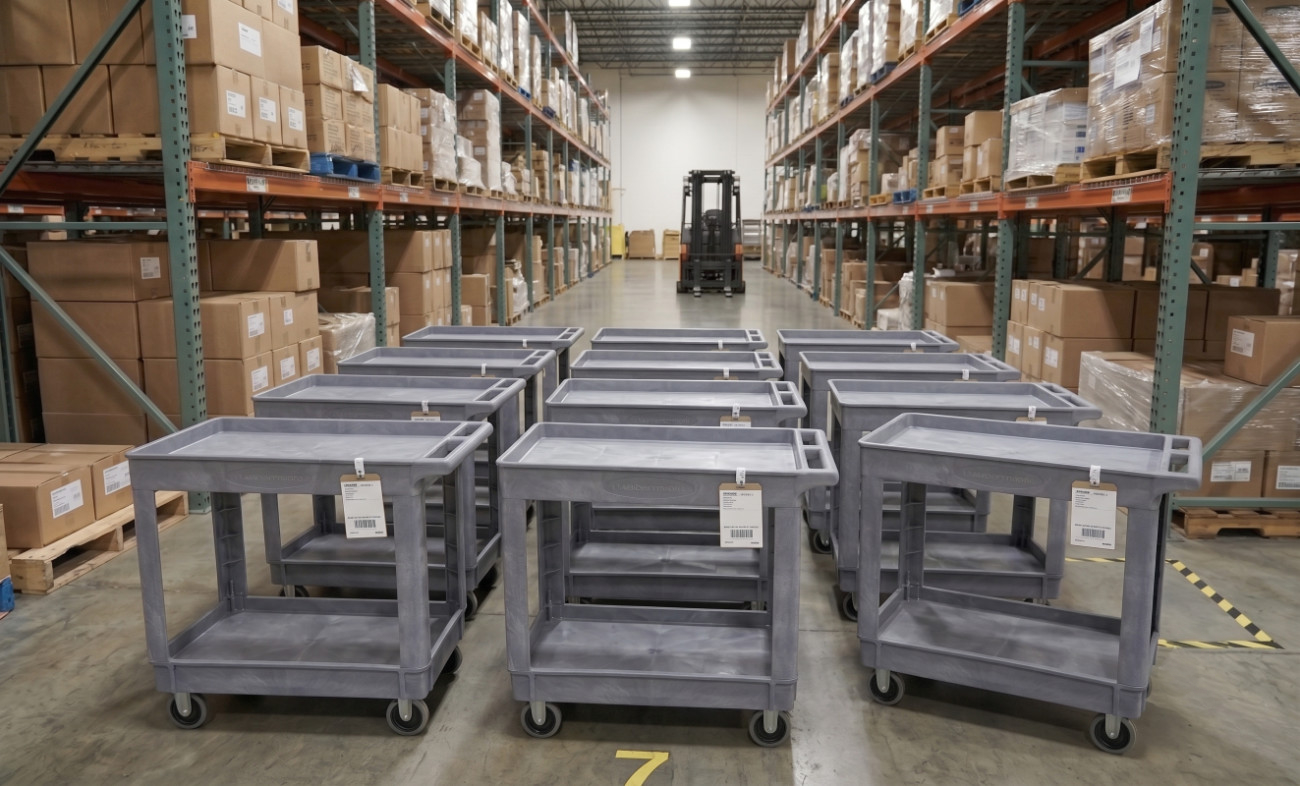 Rows of new grey plastic utility carts, manufactured using structural foam molding, ready to ship
Is Structural Foam Right for Your Part?
Structural foam is worth a look any time a part has a dimension past about twelve inches, thick walls, heavy load requirements, or a multi-piece assembly that could become one part. Send us the model and we'll tell you if structural foam is the right fit. If it's not, we run traditional injection molding too and can support the part either way.
How Structural Foam Molding Works
Structural foam molding is a low-pressure injection process. Instead of relying on machine pressure alone to fill the mold, a chemical blowing agent is introduced into the plastic melt. The blowing agent expands during injection, helping the resin fill and pack the tool while producing a cellular core inside the part with a solid outer skin. The result is a part that is roughly 10 to 15 percent lighter than the equivalent injection-molded part, with higher rigidity per unit weight, less residual stress, and less warpage.
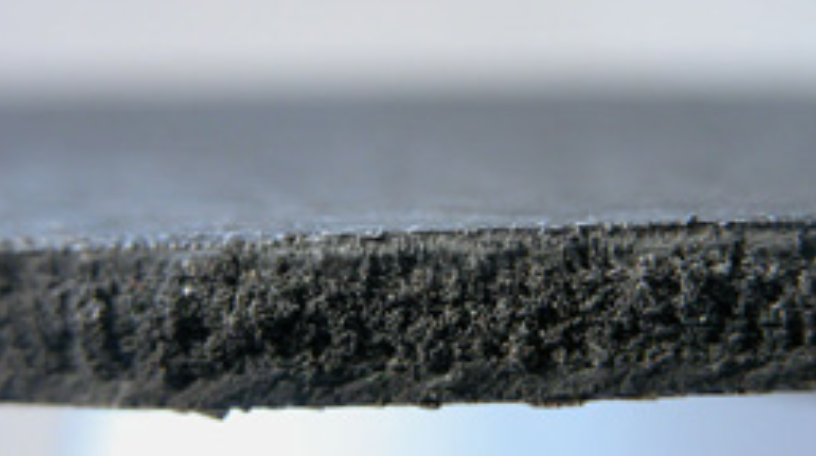 Cross-sectional close-up of a structural foam molded wall, showing the cellular foam core sandwiched between solid outer skins
The process produces large parts on smaller-tonnage presses than high-pressure injection would require, because the lower cavity pressures (a function of the blowing agent doing some of the fill work) reduce the clamp force needed. That same low-pressure characteristic also allows for aluminum tooling instead of hardened steel, which lowers tool cost and shortens lead times.
There are four common process variants inside the structural foam family: single-nozzle, multi-nozzle, gas-assist (also called structural web), and combinations of these on multi-cavity tools. Which one fits your part depends on its size, complexity, surface requirements, and production volume. The next section covers when to spec each.
Process Selection Inside Structural Foam
Single-Nozzle Structural Foam
Single-nozzle is the simplest form of structural foam molding: one injection point, the resin and blowing agent mixture flowing from a single location to fill the cavity. It works for small-to-medium parts with relatively simple geometry — parts that can fill from one gate without flow-front issues at the extremes of the tool. The cosmetic trade-off with single-nozzle is that the as-molded surface typically shows some flow lines and swirl, particularly farther from the gate. If the part has cosmetic requirements, multi-nozzle or gas-assist generally produces a cleaner surface, and secondary finishing can clean up what process selection cannot.
 A structural foam molded decorative garden arbor produced via single-nozzle structural foam molding, showing the as-molded dark green finish
Multi-Nozzle Structural Foam
Multi-nozzle is the workhorse process for large or complex structural foam parts. Instead of a single injection point, the press's platen contains many nozzle positions on a six-inch grid pattern, allowing the molder to place multiple gates wherever the geometry requires. Shot size, sequence, open and close timing, and gas-assist parameters are controlled independently at each nozzle.
Two production scenarios where multi-nozzle is the right answer:
- One large part with multiple nozzles feeding it (a single 60-inch enclosure might use four to ten nozzles);
- Multiple smaller parts running simultaneously on the same press in a family-tool arrangement.
Multi-nozzle also typically produces a better cosmetic surface than single-nozzle because the flow lengths from each gate are shorter, and weld lines can be engineered to fall in less-visible locations.
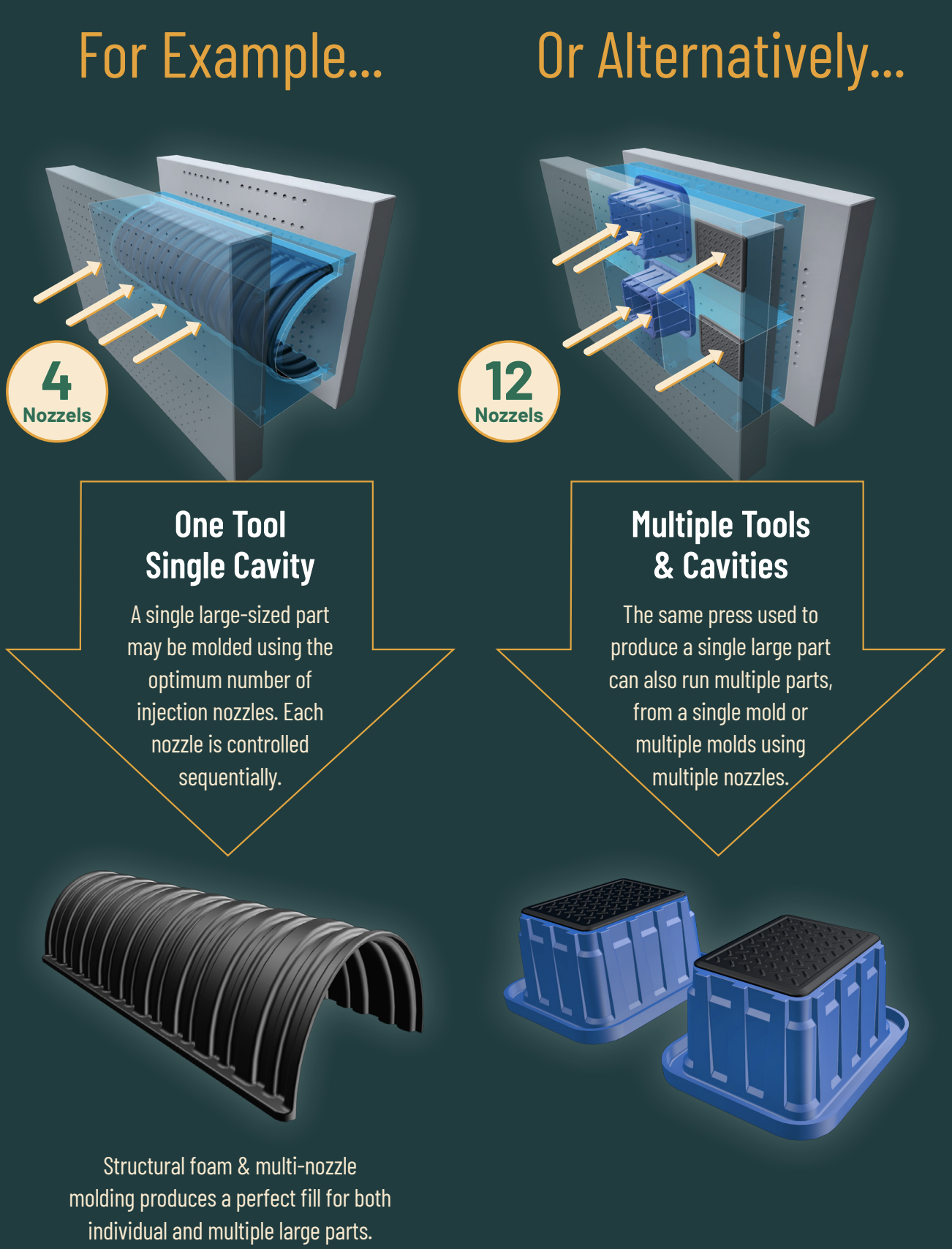 Two illustrations of multi-nozzle structural foam molding setups: a single large part being filled by four nozzles, and a family-tool arrangement with twelve nozzles producing multiple parts in one press cycle
Gas-Assist (Structural Web)
Gas-assist molding introduces pressurized gas during injection, alongside the resin. The gas pushes the molten plastic into hard-to-reach geometry, hollows out internal channels in thicker sections, and produces a cushion that compensates for shrinkage as the part cools.
The benefits, in order of how often they matter:
- Taller ribs and bosses can be molded without sink marks on the cosmetic side.
- Thinner walls than standard structural foam are achievable on parts where weight or cycle time matter.
- Surface cosmetics are typically the smoothest of the structural foam variants.
- Internal gas channels add rigidity in specific locations without adding solid wall thickness everywhere.
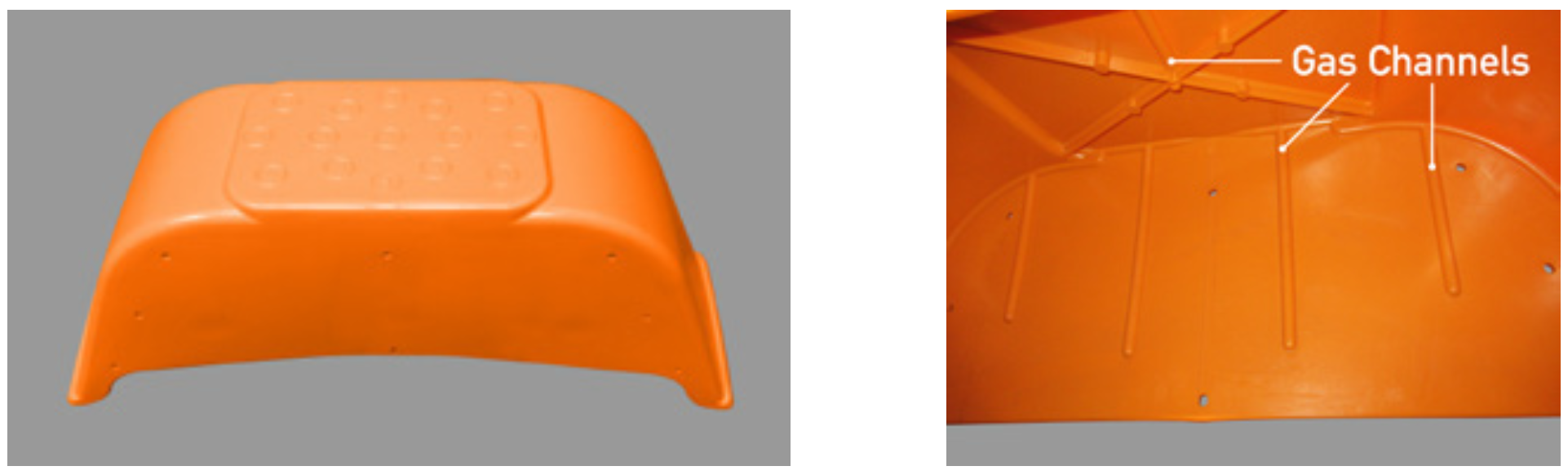 A gas-assist structural foam molded garden tractor fender, shown from above (smooth orange exterior) and from below (with internal gas channels visible)
On parts where any of the four above are critical — and especially where bosses and ribs are tall, walls are at the thin end of the range, or the cosmetic spec is tight — gas-assist is the right tool. It does add complexity (gas pin design, venting before mold opening, pressure control), which is why it is not specified on every part by default. But when the geometry calls for it, nothing else in the structural foam family does the job as cleanly.
Selection Rule of Thumb
If your part is small to medium, simple in geometry, and not cosmetically critical, single-nozzle is likely the right answer and the cheapest path. If your part is large or complex, multi-nozzle. If your part has tall features, thin walls, or tight cosmetic requirements, gas-assist (often in combination with multi-nozzle). In practice, the call usually happens in the design review — send us the geometry and we will tell you which process fits, and why.
Press Capability and Part Envelope
Press tonnage across our partner facilities runs from 300 to 8,000 tons, structural foam capable across the range and with gas-assist available on most presses. The fleet spans single-shot capacity for small structural foam parts (300-ton Uniloy Milacrons) through large-platen presses running 60-plus-inch parts in a single shot. Aluminum tooling is standard; lower cavity pressures inherent to the structural foam process make aluminum a sound choice rather than a compromise.
The right way to think about part envelope is by tie bar spacing, not platen size. The mold has to fit between the tie bars in at least one direction, less whatever clearance the mold geometry requires. Platen size constrains the upper bound, but tie bar spacing is the practical constraint a design engineer should be sizing against on real parts.
- Single-shot parts: As large as tie bar spacing allows on the appropriate press. On larger presses in the network, that means parts well over six feet in each direction.
- Flat panel parts: Up to 13 feet by 6 feet on large-platen presses.
- Maximum part weight: Over 300 pounds in a single shot, achievable on the 8,000-ton press.
The 8,000-Ton Press Profile
One of the largest injection presses installed in North America. 325-pound twin-injector shot capacity. 160-inch by 156-inch platen. 340 inches of daylight. Structural foam capable with gas-assist. For parts at the upper limit of what structural foam can produce in a single shot, this press is the network's anchor.
Have a part that fits this envelope? Send us the geometry.
Request a QuoteIndustries We Mold For
Active production verticals where structural foam is the right fit and where we have current capacity:
- Stormwater management: Large outdoor parts requiring weather resistance, chemical resistance, and structural rigidity. Drainage systems, in-ground enclosures, sumps, and related components.
- Lawn and garden retail: Consumer outdoor products with cosmetic finish requirements and outdoor durability. Decorative components, structural garden products, large display pieces.
- Building and construction: Architectural panels, large rigid components, and weather-exposed parts. Components that need to handle long service life in outdoor or semi-outdoor environments.
- Pool products: Large molded components for pool equipment, decking, and water-feature systems. Weather and chemical resistance are non-negotiable on these parts.
- Telecommunication housings: Enclosures with impact resistance, weather resistance, and integrated mounting features for cable management and equipment hardware.
- Dunnage and material handling: Industrial pallets, totes, carts, dollies, work surfaces. Durability and weight ratio matter; cosmetic spec generally does not.
- Burial products: Large rigid parts requiring weather and corrosion resistance, with long service-life expectations.
- Catalog sales: Repeat-order programs that benefit from stocking agreements and predictable production schedules.
Working With Structural Foam Molding
The shape of a structural foam program from first call to first delivery:
Design review and quoting
Send us the geometry — STEP file, IGES, native CAD, or a 2D print if that is what you have. We review the part for process fit (structural foam, or a different process if your part is better served elsewhere), flag design changes that would reduce cost or improve manufacturability, and return a quote against the reviewed design. Early engagement is consistently the cheapest path to a working tool — the most common revisions we make at this stage are wall thickness adjustments, boss redesigns, tolerance refinements, and gating recommendations, all of which are free to change in CAD and expensive to change in steel.
Tooling
Standard tooling lead time is 12 to 16 weeks from PO to first article, on a typical aluminum structural foam tool, after CAD is complete. The range covers the spread between simple single-cavity tools and more complex tools with multi-nozzle layouts, family tooling, or other complexity factors. Anything beyond 16 weeks is unusual and tied to specific design complexity.
Production
Standard production lead time is 4 to 6 weeks from PO, with material lead time often the larger factor. For programs running on shorter cycles, material stocking and finished-goods stocking agreements significantly reduce response time on repeat orders. Stocking arrangements are worth discussing early in the program — they often save more on inventory and response time than they cost on holding.
Beyond structural foam
Structural foam is one of several capabilities in our network. High-pressure injection molding, insert molding, prototype tooling, and other plastic-molding services are available across the family of companies. If your program needs multiple processes — a structural foam main body plus injection-molded components plus assembly — we can run the whole thing in-network.
Have a part in design or a program in planning? Send us the geometry and we will review it.
Request a QuoteDirect Lines: Phone: (801) 717-5870 | Email: sales@milesproducts.com