
Specifying “HDPE” on a technical drawing is rarely sufficient for those experienced in the plastics industry. Validating a process at Structural Foam Molding or defining material requirements for Miles Products requires selecting a resin grade that is just as critical a variable as the part geometry itself. When discussing High-Density Polyethylene (HDPE), we are analyzing a spectrum of quality, performance, consistency, and cost. Engineers, procurement officers, and program managers must differentiate between Virgin Prime, Wide-Spec, Reprocessed, and Regrind to balance budget constraints against performance requirements & margin. The following technical breakdown is essential before you finalize your print.
Resin Grades in 90 Seconds
A quick walkthrough of the four HDPE resin grades covered below and how each one trades off consistency, certification, and cost. Watch it first to see where your part falls on the spectrum, then read the detailed breakdown.
- Virgin prime
- Wide-spec
- Repro
- Regrind
Video runtime: 1:31
Virgin Prime HDPE: The “Cadillac” Option
Virgin Prime represents newly polymerized resin manufactured to precise technical specifications. Processed once from raw petrochemical feedstock, it contains zero recycled content or impurities. The primary justification for this selection is its superior quality and process capability. Manufactured under stringent process controls, lot-to-lot rheological and mechanical properties are highly uniform. Applications involving medical devices or food-contact packaging often mandate the use of Prime to satisfy regulatory standards & performance criteria, which it is certified to meet. While this option carries the highest raw material cost, it provides value through material certifications (COAs) and reliable technical data sheets (TDS). This ensures steady behavior during the molding process and validates that the material meets all engineering design factors.
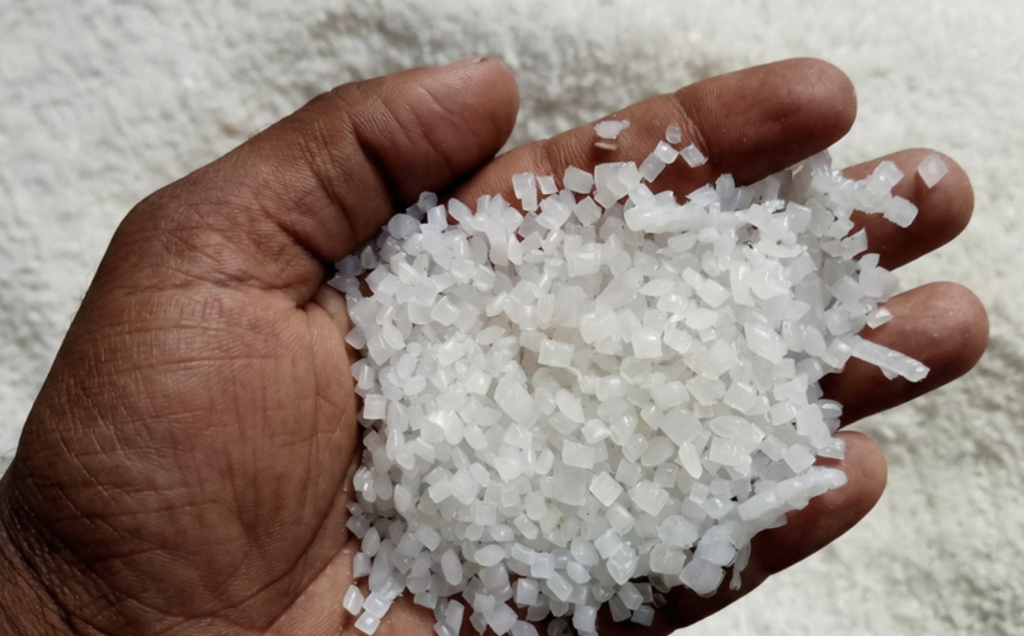
While Virgin Prime HDPE carries the highest raw material cost, it provides value through material certifications (COAs) and reliable technical data sheets (TDS):
| Property | Test Method | Typical Values | |
|---|---|---|---|
| English | SI | ||
| Melt Flow Rate, I2 @ 230°C | ASTM D1238 | 12 g/10min | 12 g/10min |
| Density | ASTM D1505 | 0.9 g/cm³ | 0.9 g/cm³ |
| Tensile Strength at Yield (50 mm/min) | ASTM D638 | 3,300 psi | 23 MPa |
| Elongation at Yield (50 mm/min) | ASTM D638 | 5 % | 5 % |
| Flexural Modulus (1.3 mm/min), 1% Secant | ASTM D790 | 165,000 psi | 1138 MPa |
| Rockwell Hardness | ASTM D785 | 90 R Scale | 90 R Scale |
| Notched Izod Impact Strength @ 73°F | ASTM D256A | 10 ft-lb/in | 534 J/m |
| Notched Izod Impact Strength @ 32°F | ASTM D256A | 2.5 ft-lb/in | 133 J/m |
| Notched Izod Impact Strength @ 0°F | ASTM D256A | 2.1 ft-lb/in | 112 J/m |
| Heat Deflection Temperature @ 66 psi | ASTM D648 | 207 °F | 97 °C |
| Heat Deflection Temperature @ 264 psi | ASTM D648 | 124 °F | 51 °C |
Virgin Wide-Spec (Off-Spec): The Cost-Efficiency Balance
“Wide-spec” or off-grade refers to virgin resin that failed to meet the tightest tolerance band required for Prime classification. This usually occurs during reactor transitions or start-up phases. Wide-spec is not a defective material. It may simply exhibit a Melt Flow Index (MFI) deviation, such as being ±15% outside the prime spec range, or a minor color variance. Process parameters for injection molding or extrusion can usually be adjusted to adjust for these rheological shifts without affecting part integrity. This grade affords a strategic balance by reducing material costs while maintaining the molecular integrity of virgin polymer. Engineers need to account for potentially higher batch-to-batch variability and the likelihood that complete data sheets may not be available for every specific lot.

Reprocessed HDPE (Repro): The Sustainable Alternative
Reprocessed HDPE, often called “Repro,” consists of plastic that has been reclaimed, cleaned, and re-extruded into pellets. This feedstock originates from either Post-Industrial (PIR) scrap or Post-Consumer (PCR) waste. A key technical distinction is the sorting process, in which recyclers separate and identify the base polymer before pelletizing. This ensures the chemical composition is known.

From an engineering standpoint, there is a major limitation. Repro generally lacks mechanical strength or certification specifications. Unlike Virgin Prime, Repro is rarely accompanied by a data sheet guaranteeing tensile yield, impact resistance, or flexural modulus. While the chemical identity has been confirmed, the mechanical performance has not been verified. The polymer chains may have undergone degradation due to prior thermal histories, affecting physical properties. Consequently, Repro is primarily specified for non-structural applications such as pallets, dunnage, or outdoor furniture, where environmental-related targets and cost reduction take precedence over critical structural guarantees.
Regrind HDPE: The Unverified Budget Option
Regrind is defined as size-reduced scrap, such as runners, sprues, or non-conforming parts, that is reintroduced into the process without re-pelletizing. While it represents the lowest cost tier, it introduces the highest degree of process variability and risk. Unlike Repro, where material is sorted by polymer type, regrind is often traceable. This means the specific chemical composition is frequently unidentified.
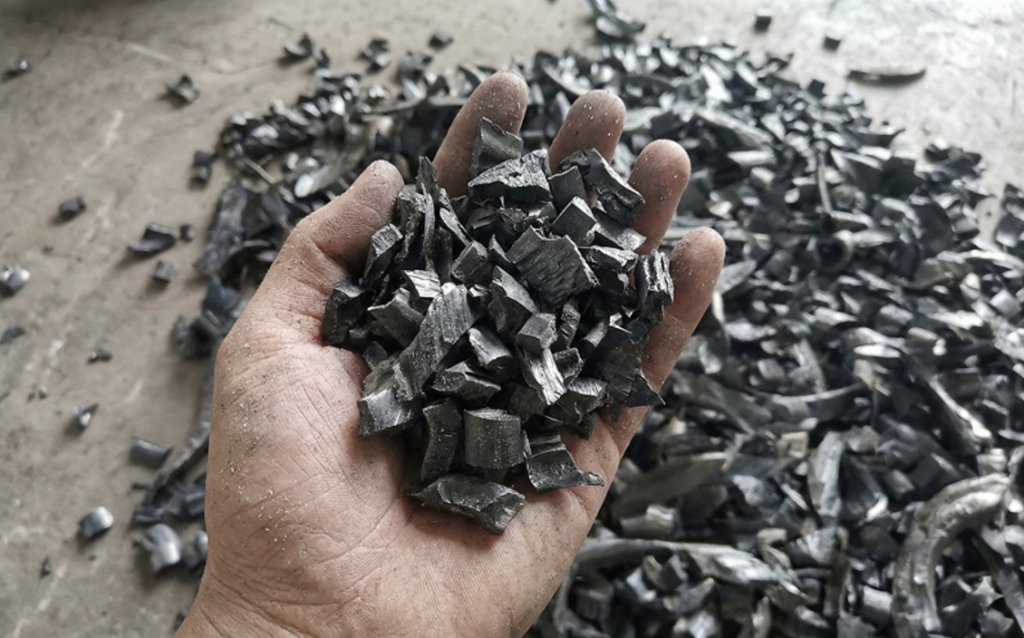
From a quality assurance perspective, regrind possesses no mechanical specifications or certification. It is an effectively undefined bulk material. Polymer degradation is a major concern because each thermal cycle can cause HDPE to undergo chain scission or cross-linking. After six to seven cycles, mechanical performance drops precipitously. The thermal history is undetermined with regrind. The commingling of various feedstocks results in a material that is almost invariably black. Because of this, usability is limited to non-aesthetic, heavy-gauge utility components, such as pallets, where material volume is prioritized over surface finish or tight tolerances.

Material selection is an optimization problem in which cost constraints must be balanced with mechanical requirements and regulatory compliance. Engineers and procurement teams often default to Virgin Prime for safety, but significant margin opportunities exist by validating Wide-Spec or Repro for less critical applications. The most effective strategy involves early collaboration with your molding partner to define the exact tolerance for variability your application can withstand. Establishing these parameters early prevents over-engineering and ensures the final product meets both technical specifications and commercial targets.
Recent posts
Controlling the Core: A Technical Look at the Gas-Assist Injection Molding Process
Posted on July 14, 2026
How to Transition from Sourcing to Purchasing Without Losing Momentum
Posted on April 22, 2026
The Benefits of Maintaining a Structural Foam Tooling Partner Across Projects
Posted on April 13, 2026